





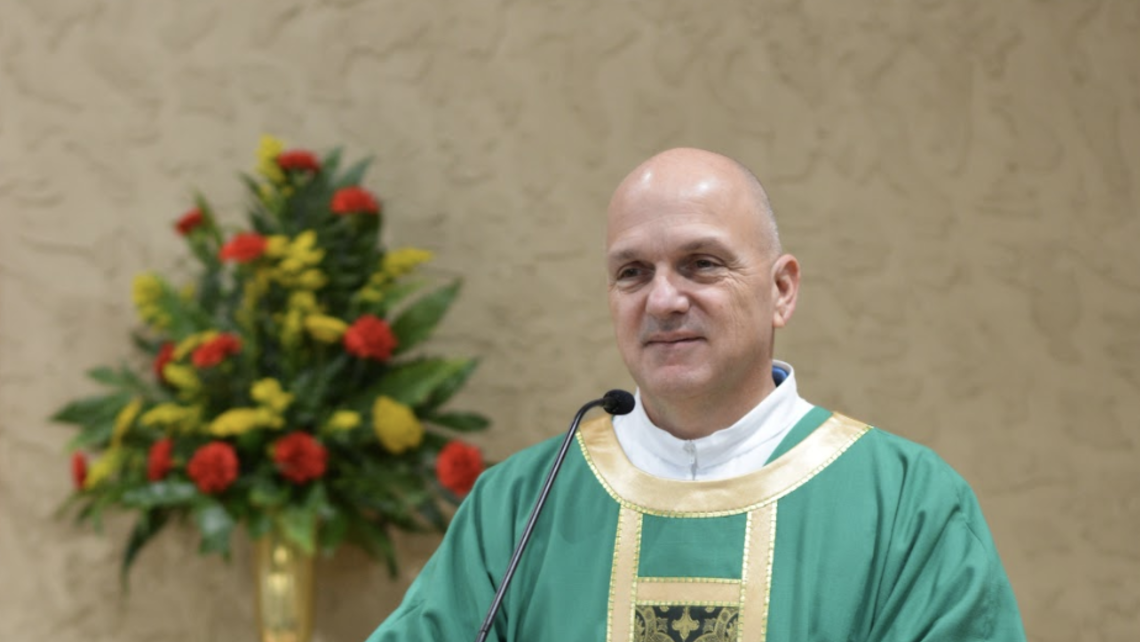
Today, as we celebrate the fifth Sunday of Easter, I would like to speak about three things; the call to service for the first deacons of the Church (in the first reading), Jesus instructing his disciples to ‘not let their hearts be troubled’ (in the Gospel), and the feast day of our patron saint – James the Younger, Son of Alphaeus.
1) The first reading from the Acts of the Apostles shows us that the early church was not exempt from trouble or complaints from the congregation. In this passage the growth of the church creates tension between the Hellenists, the Greek speaking Jews, and the Hebrew, or Aramaic speaking, Jews. The Hellenists were concerned that their widows were being neglected in the daily distribution of basic necessities.
The twelve apostles called the community of disciples together and advised them that they should not neglect the word of God and needed assistance with the distribution of basic necessities. Therefore, they should ‘select seven reputable men, filled with the Spirit and wisdom, whom they shall appoint to this task.’ The proposal was accepted and the first seven deacons of the church were selected. This created the hierarchy of priests and deacons, where the priests would focus on the word of God, the Eucharist, and pastoral concerns. The deacons would serve the immediate needs of the people.
As a result, the role of the deacon has been around since the early church, but fell out of popularity over the course of the centuries. The resurgence of the permanent diaconate is just one of the many things that came about as the result of the Second Vatican Council, which occurred from October 1962 to December 1965. Here in the diocese of Charleston, like many dioceses across the country, there has been tremendous growth in the permanent diaconate.
The path to the permanent diaconate in this diocese consists of an application process every two years. The next applications will begin to be accepted this summer, with an anticipated ordination date of February 2033. The process consists of the pastor agreeing that the permanent diaconate might be a good fit for the person, an extensive online application, interviews, acceptance into the program, one year of discernment, four years of college level courses (resulting in either credits towards an undergraduate degree or a master’s degree) in Theology, canon law, and homiletics. There is also practical training over the five years to ready the potential new deacons for the many different aspects of parish life and liturgy they will be responsible for.
When the permanent deacon is ordained, the bishop lays his hands on the candidate and the new deacon receives and indelible mark on his soul. The new deacon makes a vow of obedience to the bishop (and his successors), and vows that if his wife predeceases him, he will remain celibate. All through discernment, formation, and ordination – the permanent deacon is reminded of his servant role. The permanent deacon reports to the bishop of the diocese and the bishop assigns him to a specific parish. The permanent deacon has a dotted line reporting to the pastor of the parish and acts as a bridge between the clergy and the lay people.
Quite often, when I’m dressed in my vestments for Mass, people mistakenly call me father. I quickly let them know that I’m a deacon, but I’m also a father that has a family. There are subtle differences in the vestments of the permanent deacon and the priest. We both wear an alb, which is the white undergarment. We both wear a cincture, which is a thin rope that is tied around our waist. We both wear a stole, however, a deacon’s stole goes from his left shoulder to his right hip and has either a chain or rope attaching the two sides of the stole. A priest’s stole goes around their neck and hangs evenly in front of their chest. The outer garment a deacon wears is called a dalmatic and has sleeves and is sewn closed on either side. The priest’s outer garment is called a chasuble and is open on both sides.
Permanent deacons can perform certain rites within the church; baptism, matrimony, and funerals. This is where we can really help take some of the heavy load off the priest, so they can focus on the liturgical and pastoral needs that only they can do; like celebrating the Mass, hearing confessions and giving absolution, and anointing the sick and the dying.
While the permanent deacon is most visible while assisting the priest at Mass, we do have many other areas where we are called to serve. Another important part of our vocation is charity outside the parish. This can come in many different forms and is dependent on the needs of the local community and the talents of the permanent deacon.
Another point I want to make is that priests are ordained to the transitional diaconate, usually their last year of seminary formation. This aligns them with the servant role of a permanent deacon and also prepares them for their ordination as a priest and the pastoral care of the people entrusted to them. The bishop assigns the priests and permanent deacons, to work side-by-side, to help their respective parish grow in hope, love, faith, and to make disciples that will help spread the good news of Jesus Christ. If any man (age 35-60) is interested in learning more about the permanent diaconate, please reach out to me, Deacon Tim, or check the information available on the diocesan website under the Office of the Permanent Diaconate.
2) In today’s Gospel passage from St John, the time had come. Jesus was about to leave his disciples to endure the passion of the cross. He knew that his imminent departure, as well as the path that lay before him, would be upsetting to them. So, he reassured them: this would not be a permanent separation. In fact, Jesus was preparing a place for them in his Father’s house and promised he would ‘come back again and take them to himself, so they could be together again’ (John 14:3).
And he was true to his word! After his crucifixion, the disciples did indeed see Jesus, risen from the dead and victorious over sin. And after his ascension, his Spirit did come to them to console and guide them as they traveled far and wide to preach the good news. And now, they have taken up eternal residence in one of the many glorious dwelling places that Jesus had prepared for them.
Jesus’ words ‘Where I am you also may be’ (John 14:3) can be reassuring for us as well. He promises to be with each of us always. He dwells in us through Baptism. He comes to us under the appearance of bread and wine in the Eucharist. He is with us through his Holy Spirit. And he is preparing a dwelling place for us, too, in his Father’s house.
This is the good news: Jesus is always present with us - both now and forever in eternity. Whatever trials we may experience, we never have to feel alone or abandoned. We can call on him for his guidance, his wisdom, and his mercy at any moment of the day or night.
So ‘do not let your hearts be troubled’ (John 14:1). The One who died and rose for us will never let us go. Even when we can’t sense his presence, know that he is with us. He is interceding for us with the Father. Even now, he is preparing a dwelling place for us, a place so wonderful that it’s beyond anything we could ever imagine!
3) Today we celebrate the feast day of our parish patron, James the Younger. According to tradition, Saints James and Philip are honored on the same feast day, May 3, to commemorate the dedication in 565 of what is now called The Church of the Twelve Apostles. This Roman basilica has relics of Saints James and Philip that were discovered in a marble sarcophagus under the high altar during renovation in 1873.
James, the son of Alphaeus, is sometimes called James the less, to distinguish him from the other Apostle James, the son of Zebedee. For all the Chosen series followers, he is also known as Little James. Although it is disputed, tradition identifies James the Less as the man who was related to Jesus and became a leader of the Church of Jerusalem. According to the Jewish historian Josephus, James was martyred around the year 62.
We don’t know that much about Saints James or Philip, but we honor them because the apostles hold a special place in our faith. We are ‘built upon the foundation of the apostles and prophets, with Christ Jesus himself as the cornerstone’ (Eph 2:20). The Church, built on that foundation, offers us stability in every troubled time. Jesus gave us the Church as part of his plan for salvation. As the Church, we are his body now. As that body we are called to bring the good news, of Jesus Christ, to all the ends of the earth and make disciples of all those we meet.
Saint James, you willingly gave your life to testify to Jesus Christ. Pray that we might be apostles in our time who draw others to Jesus. Amen.
Latest Homilies
March3, 2026
October is Respect Life Month, and today is Respect Life Sunday. Each year at this time, the bishops of the United States call us...Read more
March 3, 2026
Twenty-seventh Sunday in Ordinary Time Cycle A
Isaiah 5:1-7; Philippians 4:6-9; Matthew 21:33-43
The other day I ran across this...Read more
September 27, 2026
This has been an amazing week for the Catholic Church. We started by celebrating the feast day of Saint Matthew on Monday, the tax...Read more